FireDome: Engineering Autonomous Wildfire Response
A look at FireDome's capsule-based wildfire defense system, from detection and targeting to wind, suppression performance, resource readiness, and responder coordination.
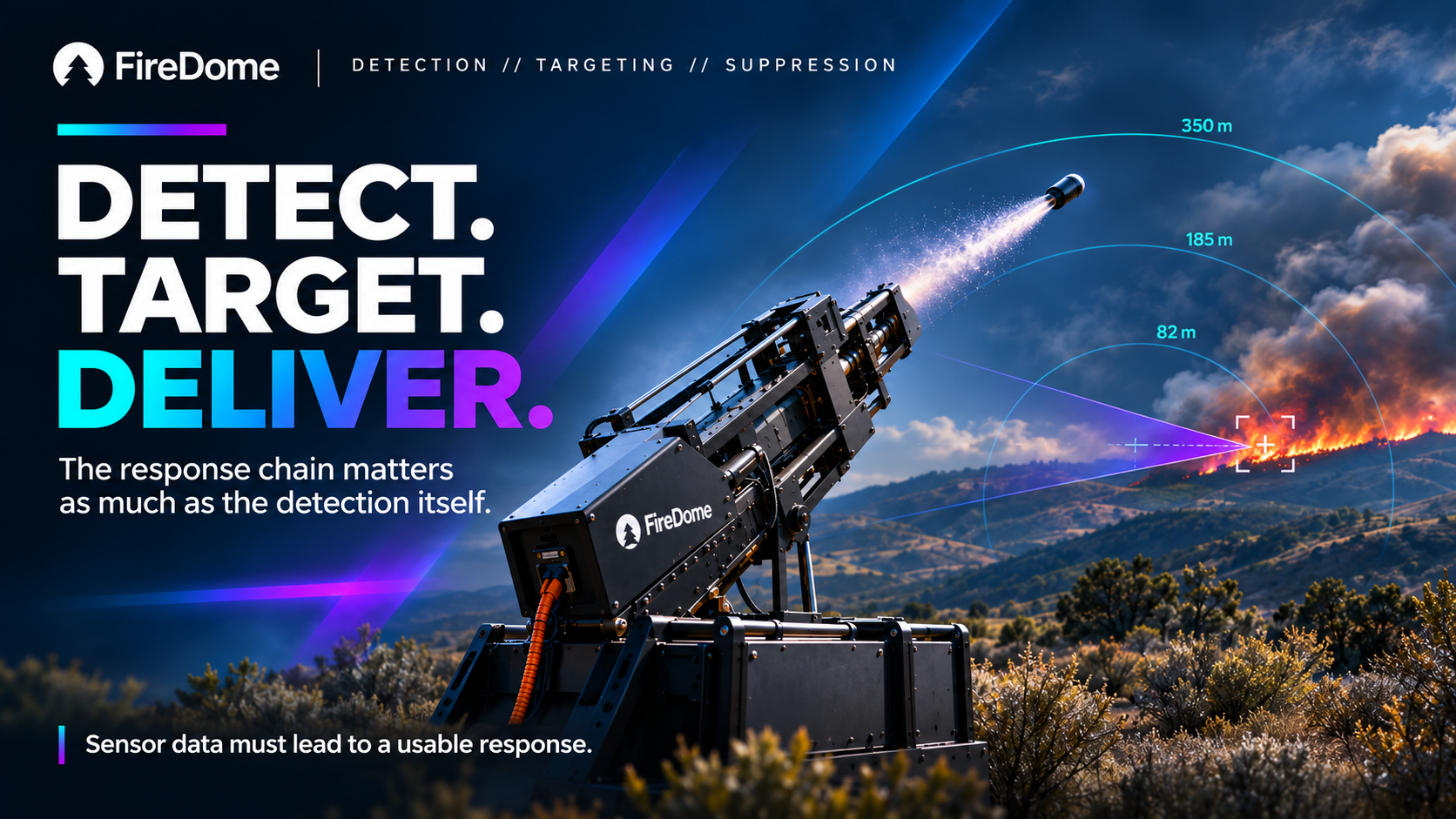
A wildfire approaches a facility, but firefighting crews haven't reached the property yet. An early warning may provide time to prepare exposed areas, while a small ignition inside the perimeter may require action before it spreads. FireDome is developing an automated system intended to address both situations by launching capsules that disperse water or retardant over selected locations.
The company announced on October 6, 2026, that it is establishing U.S. operations centered on a demonstration and test site at Yuba County Airport in California. According to FireDome, the site includes offices, a control room, and an area to evaluate detection, targeting, and suppression. The announcement describes preparation for commercial deployment, not a completed installation protecting the airport itself.
The engineering interest lies in what an installed response system might do before additional firefighting resources arrive. Its value depends on more than launching a capsule at a target. Detection, delivery accuracy, suppression effectiveness, safe operation, and remaining response capacity must work together under the conditions the property is likely to face.
From Prototype Demonstration to Site-Level Validation
FireDome's California testing program follows earlier demonstrations of its technology. In October 2025, the company announced what it described as its first real-world demonstration, reporting that the system had detected, targeted, and suppressed spot fires through automated capsule delivery. Its account also identified launcher movement, midair capsule activation, and firebreak creation among the demonstrated functions.
The Israel Innovation Authority subsequently described a full-scale prototype built at Mikveh Israel and demonstrated locally. The authority has supported the company, so its account should be understood as reporting on a project it has helped develop. The available sources support describing prototype operation in Israel, but they do not establish that every reported demonstration occurred at the same location.
Together, those accounts establish the development history behind the U.S. site. FireDome has reported operating a prototype and conducting demonstrations, while the California facility provides a location for further evaluation. The reviewed material does not provide an independent performance assessment across a defined set of environmental conditions, target types, and suppression scenarios.
This distinction matters when moving from a demonstration to a facility design. A successful test under one set of conditions shows what happened during that test. It does not establish the probability of successful detection, delivery, or suppression at another property with different vegetation, structures, terrain, and weather.
For a prospective owner, the next step is therefore to define the operating conditions and protection tasks the installation would be expected to support. The relevant question is not whether a launcher has demonstrated its mechanism, but whether the complete system can perform the required intervention at the intended site.
Two Response Paths, Each with Different Dependencies
FireDome describes a system intended to provide perimeter treatment, coat exposed assets, and suppress spot fires. Its public materials identify visual and thermal sensors, a decision engine that calculates capsule trajectories, and an electromechanical launcher. The Israel Innovation Authority describes a mechanism that operates without explosives and uses its own water supply.
The two principal response paths begin with different information. Perimeter treatment is intended to follow an external warning of approaching wildfire exposure, allowing the system to prepare selected areas before the threat arrives. Spot-fire suppression begins with detection of a local ignition and proceeds toward an intervention within the protected property.
The distinction has practical consequences for system design. An external warning must reach the installation and initiate the appropriate authorized treatment sequence. A local ignition requires the system to detect the event, identify a relevant target, deliver the capsule, and produce a useful suppression effect. Both paths may use the same physical equipment, but their initiating conditions and acceptance criteria are different.
Windborne embers help explain why addressing the perimeter and interior separately matters. The National Institute of Standards and Technology identifies embers as responsible for most structure losses during wildland-urban interface fires. Embers can ignite materials outside buildings, reach combustible vegetation, enter structures through openings, and produce additional fires after the main fire front has passed.
A treatment strategy built around this exposure needs to identify what it protects and how the proposed intervention is expected to help. Coating a vulnerable surface, treating an area ahead of an approaching fire, and suppressing an ignition are related activities, but they should not be represented as interchangeable outcomes.
Commissioning should preserve those distinctions. An advance-treatment test can follow the sequence from receiving an external warning through authorized material delivery. A spot-fire test can follow local detection, targeting, capsule delivery, and the resulting suppression. Each sequence needs its own evidence of what occurred.
Safe operation is another part of the same architecture. FireDome's 2025 release lists detection of people, animals, vehicles, and aircraft among its demonstrated functions, while its website describes safety layers before and during launches. The available descriptions do not fully explain how those detections change launcher behavior, and the reviewed material does not include a published validation protocol with results across specified operating conditions.
That makes operational authority important. A facility must establish who can activate the system, interrupt an intervention, and coordinate its operation when firefighters arrive. People entering a treatment area, vehicles using an access route, or responders establishing a work zone can change the conditions around the launcher. These situations require procedures developed with the supplier and the appropriate fire service, not assumptions about undocumented automated safeguards.
Range, Wind, and the Difference Between Delivery and Suppression
FireDome states that its launcher can reach up to 1,000 feet and that each system is designed to protect up to 70 acres. The October 2026 announcement also claims the system can continue operating in high winds. These figures and descriptions come from FireDome; the announcement does not publish the test conditions needed to establish a general performance envelope.
Wind is especially important because it affects both the wildfire threat and the delivery mechanism meant to respond to it. In November 2025, FireDome told Wildfire Today that testing under more challenging conditions was continuing, including varied wind conditions capable of moving capsules off course. The reviewed sources do not establish a current relationship between wind speed, delivery accuracy, and suppression performance.
Maximum launch distance is therefore only one part of the design question. The system also needs to observe the intended area, determine where to deliver material, and achieve the necessary treatment or suppression there. Buildings, vegetation, slopes, and local conditions can affect different stages of the process.
A target may be within the advertised launch range but still present difficulties for sensing or effective treatment. Similarly, a capsule arriving in the intended area does not automatically establish that enough water or retardant reached the relevant surface or fuel to achieve the desired result.
For a facility assessment, the useful starting point is a set of defined protection tasks. One area may require observation for new ignitions, another may require advance treatment, and a third may contain exposed equipment where targeted delivery is expected to reduce a particular hazard. Each task should be evaluated against the system's documented and demonstrated capabilities.
Acceptance testing can then distinguish between detection, targeting, delivery, and the resulting effect. Recording environmental conditions, the intended target, the actual delivery location, and the observed result would provide more useful evidence than a successful launch alone.
That distinction also determines how performance claims should be interpreted. A manufacturer may demonstrate that its launcher reaches a specified distance or operates during a particular wind condition. Whether the entire installation can deliver effective protection over the intended property requires evidence connecting those individual capabilities to the actual suppression task.
Operational Readiness Includes Remaining Suppression Capacity
An automated response system may be technically available without being fully prepared for every assigned intervention. Capsule delivery consumes resources, and perimeter treatment, asset coating, and repeated spot-fire suppression all draw on the installation's available material.
The operational question changes after each action. A launcher may remain functional and connected while having less material available for another response. For the owner, equipment health and remaining suppression capacity are therefore different aspects of readiness.
A useful operational model would make available material, equipment condition, energy, and communications status understandable to the facility team. It should also distinguish a system capable of completing an assigned treatment from one that needs replenishment or maintenance before repeating the task.
FireDome describes remote monitoring, alerts, a mobile application, maintenance services, and independence from local utilities. Those published descriptions establish the company's intended management approach, but the reviewed material does not specify resource endurance or replenishment arrangements during an extended wildfire incident.
These gaps affect operational planning. If the system treats a perimeter and later detects multiple spot fires, the site team needs to know what response capacity remains and which actions are still possible. Without that information, a general indication that equipment is online would provide an incomplete picture of its operational readiness.
The same principle applies to maintenance and handover. An owner needs defined responsibilities for inspection, replenishment, equipment servicing, and communication with responding agencies. The necessary procedures depend on the actual product configuration and service model, which the public descriptions reviewed for this article cannot fully establish.
FireDome's development discussion already includes coordination with local responders. In a September forum later summarized by 1BusinessWorld, FireDome adviser and former U.S. Fire Administrator Lori Moore-Merrell described working with fire departments to share future system locations with responding organizations and establish how to activate installations.
The October 18 article reports a discussion involving the company's CEO and adviser, rather than an independent performance assessment. It nevertheless identifies an important operational dependency: a property-installed suppression system must fit into the work of responders who may arrive while it is active or after it has already used part of its available resources.
Designing the System Around a Facility's Protection Tasks
For physical-security and infrastructure engineers, FireDome raises a broader design question about site-based autonomous response. Conventional monitoring systems can identify events and notify responsible personnel. FireDome proposes adding an intervention already positioned at the property, with the potential to act while external resources are still traveling or engaged elsewhere.
That model's effectiveness depends on connecting detection to a specific protective outcome. A site assessment should begin with the areas and assets that need protection, the hazards they face, and the interventions the proposed equipment is expected to perform. Sensor coverage, targeting geometry, environmental conditions, and treatment effectiveness then become parts of the same engineering problem.
This approach also creates a clearer basis for commissioning. Rather than checking only whether the equipment communicates, detects a test target, or launches a capsule, the acceptance process can evaluate a complete response sequence under documented conditions. The result should show what initiated the intervention, where material was delivered, what was treated or suppressed, and what the system remained capable of doing afterward.
The operational record would also help define the division of responsibility between the developer, facility owner, service provider, and local fire service. Equipment maintenance and remote monitoring fall under that relationship. Decisions about activation, interruption, firefighter access, and coordinated response belong to the broader operating procedure.
Any integration with existing facility systems would need separate technical evidence. The reviewed public descriptions do not establish compatibility with a particular video management system, physical security information management platform, building management system, or fire alarm system. Those connections should not be specified without confirmed interfaces, documented capabilities, and agreed operating procedures.
The commercial timeline also remains provisional. FireDome's 2025 announcement anticipated U.S. installations in 2026, while its October 2026 release places initial customer installations in 2027. The reviewed material does not explain the change, and the California site should be understood as a testing and demonstration operation rather than evidence of a completed commercial protection deployment.
The most useful next evidence would describe the full response under clearly stated conditions, including the initiating event, detection result, targeting decision, capsule delivery, observed treatment or suppression, and remaining resources. Such information would allow an owner to evaluate the proposed system against the protection tasks that matter at a particular facility.
FireDome's engineering significance lies in the possibility of positioning an automated intervention where wildfire exposure may occur. Whether that possibility becomes a dependable site-protection capability will depend on demonstrating that the entire response, from warning or detection through useful suppression, can be performed safely and repeatedly within defined operating limits.
Sources & Further Reading
FireDome — Official Technology, Solutions, and Service Information
Israel Innovation Authority — Burning Changes in Extinguishing Fires (December 14, 2025)
NIST — How Fire Spreads in the Wildland-Urban Interface
Wildfire Today — An 'Iron Dome' to Suppress Wildfires (November 13, 2025)
1BusinessWorld — Extending the Reach of Wildfire Response (October 18, 2026)
About the author
- IT Security Systems Designer focused on connected security, video surveillance, networking, cloud, edge AI, access control, and infrastructure architecture. I write about how security systems increasingly overlap with IT, cloud, networking, and modern infrastructure.
Comments
Join the discussionNo comments yet. Be the first to comment.
Connected Security & Infrastructure
A technical series exploring the convergence of physical security, networking, cloud, edge AI, video surveillance, access control, and modern infrastructure architecture.