ANYmal at Whitegate: Robot Identity Meets Access Control
A live industrial pilot shows how digital credentials, access authorization, and automated doors become part of an autonomous inspection route.
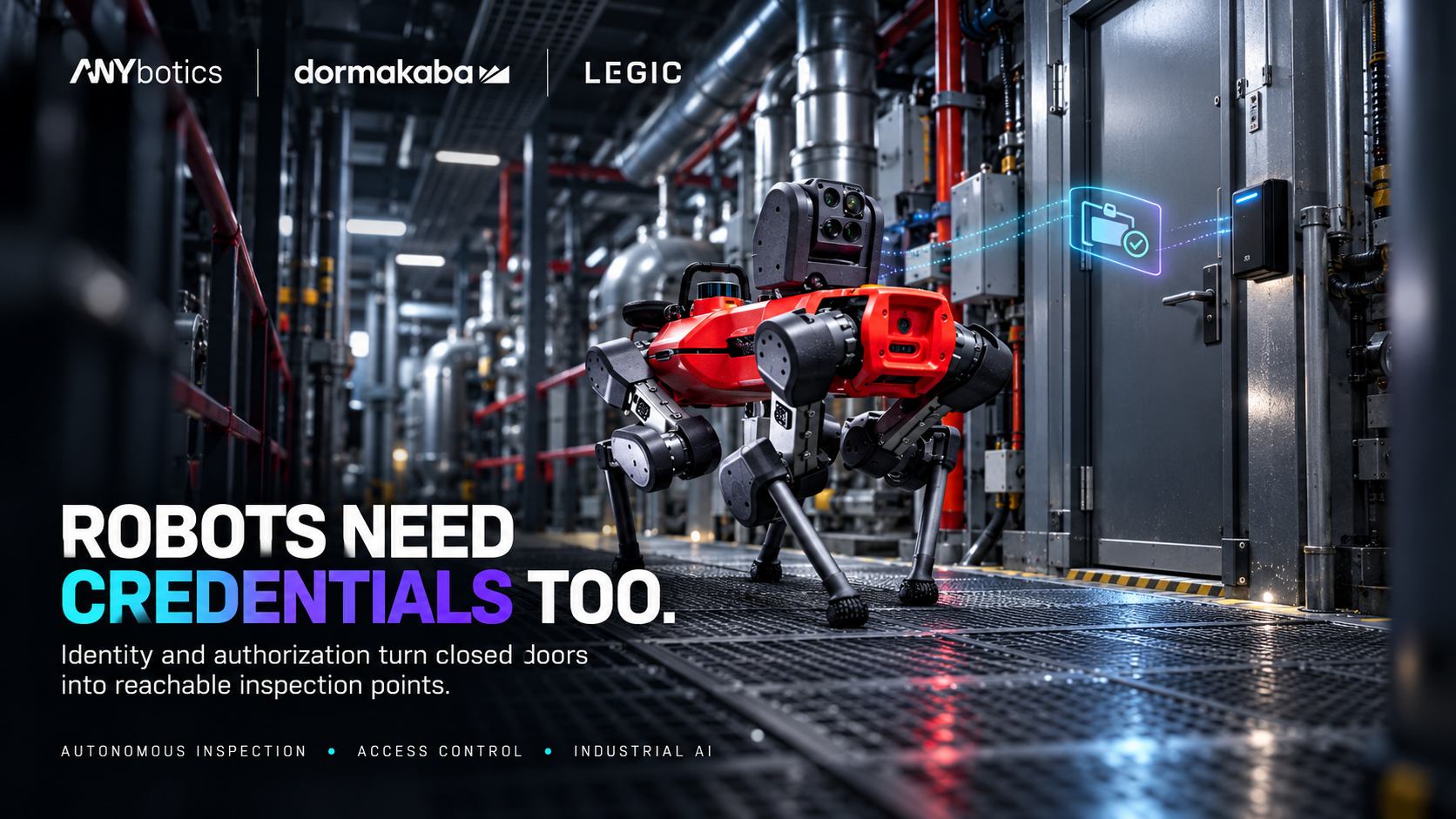
An autonomous inspection robot can navigate an industrial facility, collect measurements, and follow a planned route. Yet its ability to reach equipment still depends on the physical boundaries of the building. When that route leads through an access-controlled door, the robot needs more than a way to open it: the facility must establish whether the machine requesting entry is authorized to enter.
A collaboration between ANYbotics, dormakaba, and LEGIC demonstrates how this requirement can be incorporated into an autonomous inspection workflow. At GE Vernova's Whitegate power station in Ireland, the companies demonstrated an ANYmal inspection robot passing through controlled infrastructure using a digital credential. The pilot involved two automated doors, including an access-controlled entrance to an electrical room.
The significance lies in the relationship between the robot and the existing building systems. Rather than treating the door as an obstacle to bypass, the integration allows the machine to interact with the facility's access-management process while the facility retains authority over entry.
The Access-Controlled Door as a Mission Boundary
Industrial inspection robots can follow planned routes, gather measurements, and revisit equipment without requiring a person to perform every inspection. Their operational coverage, however, depends on whether the facility's physical layout permits them to reach the necessary locations. A closed door can separate operational areas, protect electrical equipment, or preserve a fire compartment, regardless of whether the robot can navigate the route leading to it.
ANYbotics identifies several earlier approaches to this problem: leaving doors open where permitted, deploying separate robots in different areas, or accepting gaps in inspection coverage. Each approach limits how an autonomous inspection route can be organized. A facility may have a robot capable of performing the required measurements while still being unable to include certain rooms in its routine missions.
Integrating the robot with the existing door infrastructure offers a different arrangement. The entrance can remain part of the facility's normal operational environment while becoming accessible to an authorized autonomous machine. For a controlled entrance, however, the integration must preserve the distinction between operating the door and granting permission to pass through it.
This distinction is central to the Whitegate pilot. The robot's mission establishes where it intends to go, but the access-management system determines whether it is permitted to enter.
Separating Door Automation from Access Authorization
The collaboration addresses two related but technically different scenarios. At a door without access control, the primary challenge is coordinating physical operation with the robot's movement. The door must open for the approaching machine, allow passage, and close afterward.
An access-controlled entrance adds an authorization requirement. Detecting the robot's presence does not establish its identity or determine whether it has permission to enter a protected area. The facility needs to evaluate the request against the access rights assigned to that particular machine and entrance.
The participating technologies divide these responsibilities. ANYbotics provides the ANYmal robot and its interaction with the door. LEGIC provides the digital credential carried by the robot, while dormakaba provides access management and door automation. The resulting integration connects the robot's movement request to an access decision administered through the facility's existing processes.
The distinction between these functions has practical consequences. A digital credential does not automate a physical door, and a door operator does not establish whether an approaching machine is authorized to enter. Both capabilities must work together for the robot to continue through a controlled passage without treating the entrance as an unrestricted opening.
The implementation also requires suitable door automation and integration. It is not a zero-touch installation in which the robot's presence alone makes an existing controlled entrance compatible.
How Identity, Authorization, and Passage Work Together
At an equipped access-controlled entrance, ANYmal presents its LEGIC credential. The access-management system checks the robot's identity and evaluates whether it is permitted to pass through that door at that time. Only after access is granted does the interaction proceed to physical door operation.
The automated door confirms that it can operate safely and opens. ANYmal then verifies that the passage is physically open before moving through it. Once the robot has passed, the door closes and the inspection mission continues.
ANYbotics describes four checks underlying this interaction: identity, authorization, safe operation, and physical verification. Each addresses a different condition. Recognizing the requester does not establish its permission, an authorization decision does not establish safe door operation, and an opening command does not confirm that the robot can physically proceed.
These relationships are important because the access-management decision and the robot's physical movement belong to different parts of the system. The facility evaluates permission, the automated entrance performs the physical operation, and the robot verifies the resulting passage before continuing its mission. Successful traversal depends on those responsibilities remaining coordinated rather than being treated as a single door-opening command.
The behavior when access is denied reinforces that separation. ANYbotics states that the door remains secured while the robot reports the issue and adapts its mission. The robot therefore does not acquire authority to override the facility's access rules merely because its planned route includes the protected area.
The companies describe access rights as centrally administered and governed by the facility's existing processes. Their public announcements do not disclose the credential transmission protocol, internal access-system data model, or detailed cryptographic implementation. Those details should not be inferred from the demonstrated interaction.
The documented architectural relationship is sufficient to establish the central principle: the robot requests entry, but the facility makes the access decision.
What the Whitegate Pilot Establishes
The operational value of this approach becomes clearer when the controlled entrance is considered as part of an inspection route rather than as an isolated demonstration. In ANYbotics' published account, an engineer at Whitegate described a room containing approximately 400 readings that had normally been collected by a contractor once a year. With the door-opening solution, the stated intention is for ANYmal to collect those readings daily.
That proposed inspection frequency represents an expected operational benefit, not a published record of completed daily inspection cycles. The potential value lies in making a previously difficult-to-reach room available to a routine autonomous mission without requiring its controlled entrance to remain unsecured.
More frequent measurements may give maintenance teams a richer view of changing equipment conditions and additional opportunities to recognize developing issues. The pilot's published material, however, does not quantify defect-detection improvements or the economic effects of the proposed inspection schedule.
The participating companies reported several weeks of live operation at Whitegate, during which ANYmal repeatedly requested access, passed through the controlled entrance, and continued its mission without manual intervention. This provides operational evidence of the interaction between the robot, access management, and automated door infrastructure in the reported pilot environment.
The available announcements do not include an independent security assessment or quantified cost and defect-detection outcomes. The demonstrated result is therefore more specific than a general claim about autonomous industrial inspection: a robot was able to use an access-controlled entrance repeatedly as part of a live inspection workflow while the facility's permission process remained part of that interaction.
That distinction is important when evaluating the deployment. The Whitegate operation demonstrates an integration model and its practical use at the pilot site, not a universal performance benchmark for every industrial facility.
Designing Robot Deployment Around Existing Access Infrastructure
A conventional autonomous inspection project involves route planning, sensing, connectivity, mission execution, and the collection of inspection data. When the route crosses controlled physical boundaries, the access-management environment becomes another part of the deployment architecture.
Robot identity and credentials must be considered alongside the facility's access permissions. Door automation must be suitable for the intended interaction, and the robot's mission behavior must accommodate the possibility that entry will not be granted. These requirements connect the robot's operational workflow to systems traditionally administered by facility operators and physical-security specialists.
The responsibilities remain distinct even when the interaction appears seamless to an operator. The robot performs the inspection mission, the access-management system evaluates permission, and the automated entrance provides the physical passage. A successful mission depends on those functions working together without allowing movement planning to replace authorization.
This also changes the questions that arise during system design and handover. Credential administration, access rights, door automation, and defined behavior following an unsuccessful access request all affect whether a robot can complete its assigned route. The physical and digital elements have to be considered together because satisfying only one part of the interaction does not establish that the complete passage is available.
These are engineering implications of the demonstrated integration rather than claims about additional undocumented product functionality. The broader change is that physical access management can become an active part of autonomous industrial operations while continuing to serve its existing purpose of controlling entry.
The robot does not need the facility to abandon its access boundaries. It needs an authorized way to operate within them.
From Controlled Doors to Broader Infrastructure Integration
ANYbotics states that the access-controlled configuration is available on request, with a full rollout planned for 2027. The partners are also exploring future applications involving elevators, gates, and turnstiles. Those possibilities extend the architectural direction of the collaboration, but they should not be confused with capabilities demonstrated at Whitegate.
The underlying engineering problem remains consistent across these potential applications. An autonomous machine needs a way to identify itself, request the appropriate permission, interact with controlled infrastructure, and verify that the requested physical action has occurred. Those requirements are separate from navigation, even though they ultimately determine whether a mission can continue.
The Whitegate pilot illustrates how these responsibilities can be connected without transferring access authority to the robot. The machine participates in the inspection process, but the facility continues to decide whether the requested movement is permitted.
For autonomous systems operating in real industrial environments, that distinction matters as much as the ability to move or collect measurements. A machine's operational autonomy depends partly on its capacity to work within the established permissions and physical boundaries of the site.
The door is the visible element of this integration. The more consequential development is the connection between the robot's mission and the facility's existing authority over access.
A robot does not need unrestricted movement to become more autonomous. It needs a dependable way to request the right access, at the right location, under rules the facility controls.
Sources & Further Reading
ANYbotics — Autonomous Door Opening for ANYmal (September 24, 2026)
About the author
- IT Security Systems Designer focused on connected security, video surveillance, networking, cloud, edge AI, access control, and infrastructure architecture. I write about how security systems increasingly overlap with IT, cloud, networking, and modern infrastructure.
Comments
Join the discussionNo comments yet. Be the first to comment.
Connected Security & Infrastructure
A technical series exploring the convergence of physical security, networking, cloud, edge AI, video surveillance, access control, and modern infrastructure architecture.